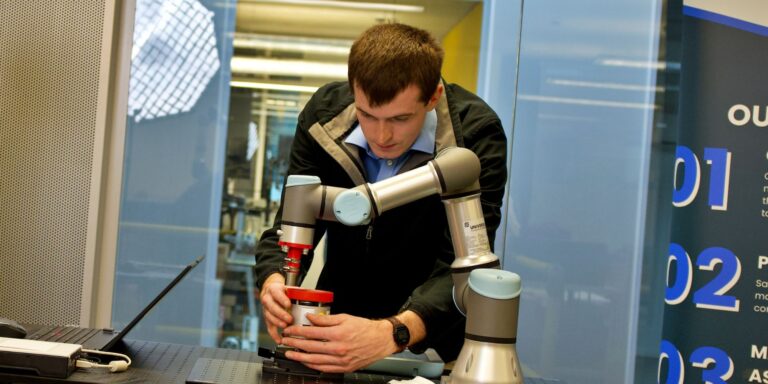
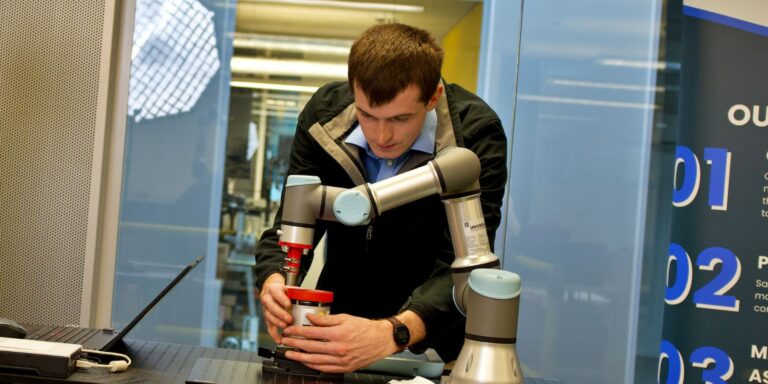
Knox Thomas measures the real collision forces and pressures on your cobot cell against ISO/TS 15066, so you know your cobot is safe in reality and not just in the settings menu.
What happens in real life can be very different from what you expected from behind a desk. That is often the case with the force and pressure risks from collaborative robots, especially once you take into account the vast range of end effectors that can be fitted to a cobot. The force and pressure at the end effector can be up to three times the values set in the system settings. The only way to find out whether your cobot is safe in reality is to test it.
Our cobot force and pressure testing service gives you measured evidence for your robot cell risk assessment, your CE/UKCA technical file and your PUWER records.
Force and Pressure Testing to ISO/TS 15066
Knox Thomas offers force and pressure testing against the requirements of ISO/TS 15066, the technical specification that sets biomechanical limits for contact between a collaborative robot and the human body. It sits alongside EN ISO 10218, the robot safety standard, and it is the document a power and force limiting application has to be validated against.
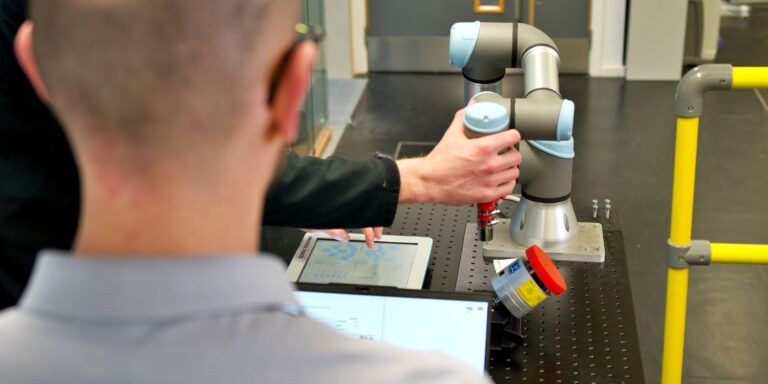
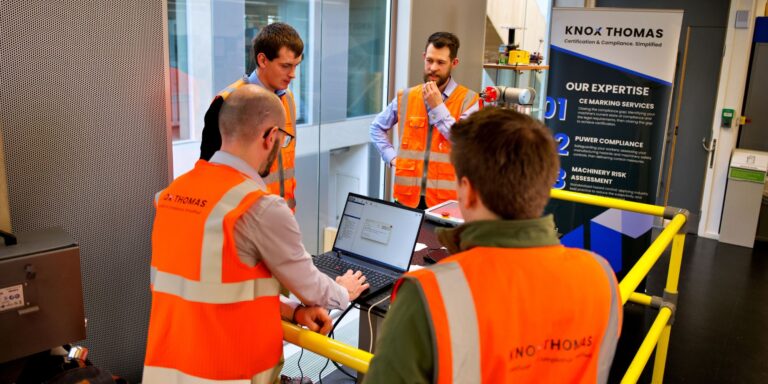
A cobot supplied as compliant with EN ISO 10218 is not automatically a safe application. The standard covers the robot. Once you add a gripper, a tool, a workpiece and a layout, the hazards belong to the cell, and the cell has to be tested. We bring the measurement equipment to your site, run the collision scenarios that match your task, and tell you which ones pass and which ones do not.
What We Measure
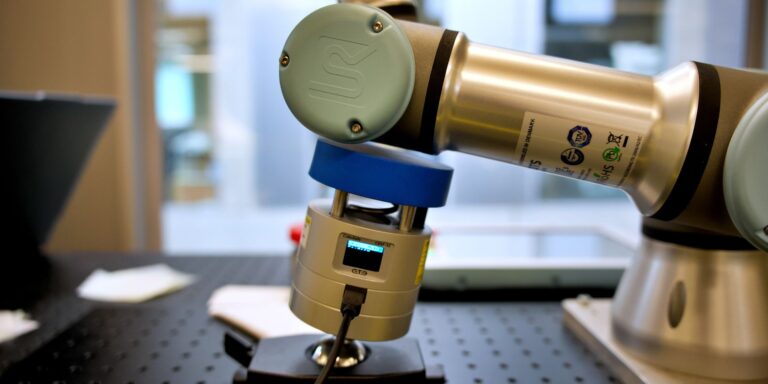
We measure two things that a cobot cannot measure for itself. Force is recorded with a cobot safety testing device, a calibrated spring and sensor that stands in for the part of the body being struck. Pressure is recorded with pressure film metrology, which shows how that force is spread over the contact area. A small contact area, such as a gripper finger or a tool edge, can exceed the pressure limit even when the force is well inside the setting on the controller.
Each scenario is run as either transient contact, where the person can move away from the impact, or quasi-static contact, where part of the body is trapped between the robot and a fixed surface. ISO/TS 15066 sets different limits for each, body region by body region, and we compare every measurement against the right one. Every end effector you use is mounted and tested on its own, because geometry and contact area drive the pressure outcome.
What We Found on a Real Cobot Cell
Our robot case study tested a torque-driven cobot cell running the manufacturer’s baseline safety parameters: 250 N maximum force, 1000 W maximum power and a programmed speed of 250 mm/s. Three findings stood out.
Pressure was the blind spot. The cobot stopped on overload as designed, but it has no way of sensing pressure, and the pressure film showed that pressure exceedance was the failure in most of the dangerous scenarios.
Force sensing spiked past the programmed value. In a locating operation set to sense 50 N, the initial impact force measured more than three times the programmed figure before the robot reacted.
Hold-position behaviour became a hazard. Where contact triggered force sensing and the program held position, the cobot did not back away the way normal collision detection would, which turned a transient contact into a trapping one.
Lowering force and speed on its own did not fix the problem. Small contact areas still exceeded the pressure limits, and a collision on a joint other than the one being monitored reached the force limit too late. These are the kinds of results that only appear when you measure the cell as built.

Our Cobot Testing Covers:
01. Transient Contact Scenarios
02. Quasi-Static Contact Scenarios
03. End Effector Testing
04. Pressure Film Metrology
05. Comparison Against ISO/TS 15066
06. Report and Recommendations
See the testing in practice
Our robot case study walks through the full method: the scenarios we ran, the manufacturer baseline we tested against, the measured forces and pressures, and the seven findings that came out of it. It is the clearest picture of what cobot force and pressure testing involves and what it can reveal.
Images credited to James Nightingale.
Cobot Force and Pressure Testing FAQs
Do I need force and pressure testing if my cobot is CE marked?
What does the testing involve on site?
Can you help if the cell fails?
Pressure film indicated that pressure exceedance, not force, was the key failure in most of the dangerous scenarios on the cell we tested.
Book a cobot force and pressure test
Tell us about your cell, the end effectors you run and where people work alongside the robot, and we will scope the scenarios and give you a fixed price. If you are an integrator building the cell, our Robot Cell Risk Assessment service covers the assessment the testing feeds into. For a free initial consultation, book an appointment via our meeting system or fill out the contact form. We aim to respond to all enquiries within 24 hours.