
A key part of applying a CE or UKCA mark to a lifting accessory is establishing its working load limit in accordance with EN 13155. Knox Thomas carries out that testing for you.
Lifting beams, spreader beams, C-hooks, vacuum lifters, grabs, clamps and bespoke attachments all count as lifting accessories under the Supply of Machinery (Safety) Regulations 2008 and the Machinery Directive. Before one can be CE or UKCA marked, the manufacturer has to prove it will carry its rated load with the margin the standard demands, and keep the test evidence in the technical file. Our lifting accessory testing can be integrated into a broader CE/UKCA compliance service or taken as a standalone service.
What Gets Tested
We test non-fixed load lifting attachments: the equipment that sits between the crane hook and the load. That covers fabricated lifting beams and spreader beams, C-hooks and coil lifters, plate clamps and grabs, vacuum and magnetic lifters, pallet forks and lifting frames, and one-off attachments designed around a particular product. If you are unsure whether an item is a lifting accessory at all, our guide to adapters as lifting accessories and the lifting accessory glossary entry set out where the line falls.
Testing is normally done at your premises or your fabricator’s, using your crane or a test rig, with calibrated test weights or a load cell. We work with you to agree the test load, the rigging arrangement and the hold time before anyone lifts anything.

The Standard: EN 13155
EN 13155 is the harmonised and designated standard for non-fixed load lifting attachments. It sets the design requirements for lifting accessories and the verification that has to back them up, including a static test at a multiple of the working load limit and, where the design calls for it, a dynamic test above the working load limit. The accessory has to carry the test load without permanent deformation, cracking or any loss of function, and the result has to be recorded.
Our guide to lifting accessories under EN 13155 explains the standard in detail. The proof load testing glossary entry covers the terminology. We apply the clauses that match your accessory type and record the test against them, so the evidence stands up when a customer, a notified body or an inspector asks for it.
How Testing Fits Into CE and UKCA Marking
For most lifting accessories the manufacturer self-certifies. The route runs from a risk assessment to design against EN 13155, verification by calculation and test, a technical file that holds the evidence, and a Declaration of Conformity. The load test is the point where the design is proven in practice, and it is the piece of evidence most often missing when we review a technical file.
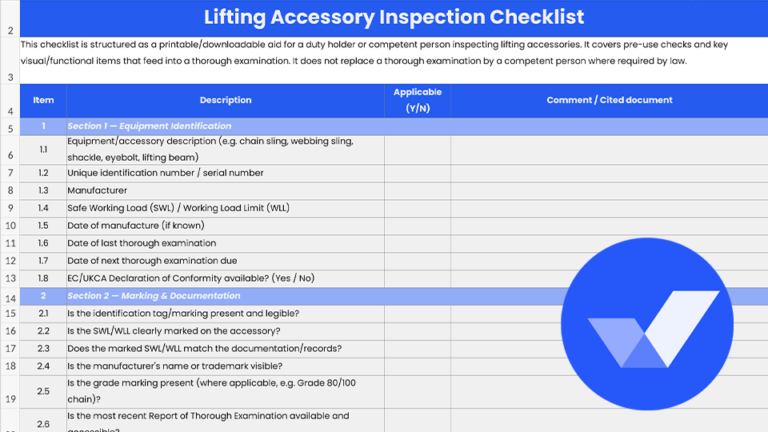
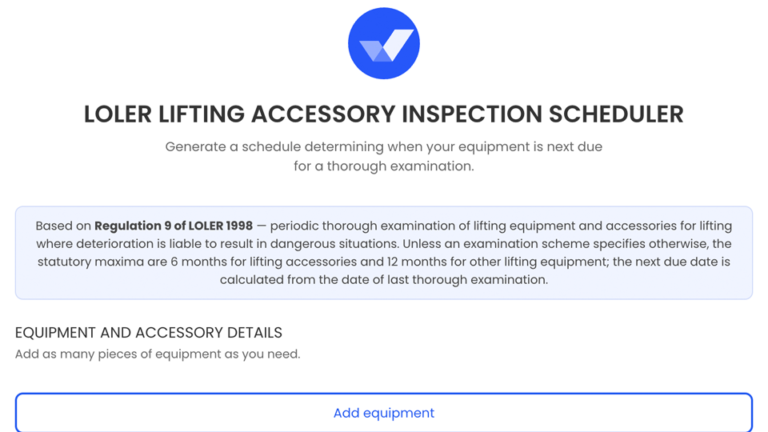
If you already have the design and the documentation, we test and report. If you are starting from scratch, we can run the whole process through our CE/UKCA Compliance Consulting service. Once the accessory is in service, LOLER applies: our lifting accessory inspection scheduler and lifting accessory inspection checklist help you keep up with the thorough examinations that follow.
Our Lifting Accessory Testing Covers:
01. Test Planning
02. Pre-Test Inspection
03. Static Proof Load Test
04. Dynamic Test
05. Marking and Documentation Check
06. Test Report
Because of KnoxThomas “we now have the assurance that our machinery meets the requirements of the applicable legislation.”
Book a lifting accessory test
Send us the drawings or a photo of the accessory, its intended working load limit and where it will be tested, and we will come back with a scope and a price. For a free initial consultation, book an appointment via our meeting system or fill out the contact form. We aim to respond to all enquiries within 24 hours.