
In lifting operations, not every item that sits between lifting equipment and a load is easy to classify.
Some products fall neatly within established categories. A chain sling is a lifting accessory. A spreader beam is a lifting accessory. A hook block is part of the lifting machinery. But then there are more awkward products: adaptors, cradles, carriers, frames, stillages, and other fabricated items designed to interface between machinery and the thing being lifted.
These are the cases that often create uncertainty for engineers, compliance teams, and health and safety professionals. The practical question is usually simple enough: can we use it? The legal and technical answer is often less tidy.
One of the grey areas we see at Knox Thomas is whether an adaptor should be treated as a lifting accessory under the Supply of Machinery (Safety) Regulations 2008, which implemented the Machinery Directive 2006/42/EC in Great Britain, and what that means in the context of the newer Machinery Regulation (EU) 2023/1230. If the item is a lifting accessory, that can trigger conformity assessment, technical documentation, and UKCA/CE marking before being placed into service in Great Britain/EU.
Why this question matters
The classification matters because if an adaptor is a lifting accessory, it is not just a fabricated metal item or a piece of workshop tooling. It becomes a regulated product.
That has consequences. It may need:
- conformity assessment under the Supply of Machinery (Safety) Regulations/ Machinery Directive
- a technical file
- risk assessment against the relevant Essential Health and Safety Requirements
- supporting calculations and design justification
- testing, often including proof load testing
- instructions
- a Declaration of Conformity
- UKCA/CE marking
- ongoing use and examination in line with LOLER
If, however, the item is better understood as a load carrier, support frame, or cradle-type arrangement, the position may be different. It may still need to be safe. It may still require engineering assessment and testing. But it may not necessarily fall into the lifting accessory category in the same way.
That distinction is exactly where the difficulty lies.
The legal background: UK and EU position
For businesses operating in Great Britain, the immediate legal framework is the Supply of Machinery (Safety) Regulations 2008. These regulations implement the core concepts and definitions found in the Machinery Directive 2006/42/EC, and much of the familiar guidance and interpretation still comes from the European machinery law framework.
That matters because, although the UK now applies its own domestic regime and UKCA marking, the wording and concepts around machinery and lifting accessories remain heavily tied to the Directive-era framework.
It is also worth being aware of the Machinery Regulation (EU) 2023/1230, which replaces the Machinery Directive within the EU framework. For businesses placing machinery or lifting accessories on the EU market, or for those wanting to understand the direction of travel in European product regulation, the Machinery Regulation is now part of the wider compliance picture.
The starting point in the legislation
The first place to look is the definition in the Supply of Machinery (Safety) Regulations 2008.
Part 2, Regulation 4(2)(d) defines a lifting accessory in terms that broadly capture a component or item of equipment that is:
- not permanently attached to the lifting machinery
- used to allow the load to be held
- placed between the lifting machinery and the load, or directly on the load, so that it can be lifted
This reflects the same basic legal idea found in the Machinery Directive and carried through into the European machinery law framework more broadly.
On first reading, that sounds wide enough to catch many adaptors.
If an adaptor sits between a loader and a cradle, or between lifting machinery and a supported item, then there is a perfectly credible argument that it falls squarely within that wording. It is not permanently attached. It is part of the lifting arrangement. It plays a role in holding or interfacing with the load path.
That is why many internal engineering teams, workshops, and duty holders initially assume that such items must be lifting accessories.
Why the answer is not straightforward
The problem is that the definition alone does not settle every case.
The EU Commission’s Guide to the Machinery Directive remains highly relevant here because the UK regulations mirror the Directive wording in this area, and the Guide has long been one of the most useful interpretive sources when dealing with borderline classification issues.
On the one hand, the Guide reinforces the idea that equipment placed between the holding device of lifting machinery and the load may be treated as a lifting accessory.
But elsewhere, the Guide introduces nuance by the examples it gives.
Some familiar items are clearly treated as lifting accessories, such as:
- C-hooks
- clamps
- lifting beams
- lifting forks
Those are easy enough to understand. Their purpose is plainly to attach, suspend, grip, or support the load as part of the lifting operation.
However, the Guide also points to products on the other side of the line, including examples such as:
- ISO containers
- forklift pallets
- stacking systems for wind turbine blades
- stillages for flat glass
These examples are important because they show that not every item involved in carrying or supporting a lifted load is automatically treated as a lifting accessory.
That is where many adaptors begin to fall into a grey area. If the adaptor behaves less like a hook, clamp, beam, or other conventional attachment, and more like a load-supporting interface, carrier, or cradle element, the classification becomes far less certain.
The significance of function

In our experience, classification often turns on function, not just physical position in the lifting chain.
A product may sit between the lifting machine and the carried item, but that does not end the analysis. The more useful question is often this:
Is the item functioning as a lifting attachment, or as a load-supporting carrier/interface?
That distinction matters.
An adaptor that is designed to connect into the machinery’s lifting point and actively serve as the means by which the load is attached may look much more like a lifting accessory.
An adaptor that primarily supports a cradle from underneath, acts as a locating interface, or behaves more like a carrier arrangement may be closer to the container/stillage side of the classification question.
That does not make it unregulated in every sense. It does mean that the case for treating it as a lifting accessory may be weaker.
The grey area has been recognised officially
This is not just a theoretical debate.
The Machinery Working Group minutes from 14/15 February 2012 are particularly useful because they show that products such as blade transport/lifting frames and flat-glass stillages were actively discussed at official level. Different member states took different positions. Some considered they should be treated as lifting accessories. Others, including the Commission view reflected in the discussion, took the opposite position. The UK accepted that either classification could be defensible depending on the circumstances.
That is an important point for engineers and compliance managers.
There is no value pretending that every adaptor has an obvious legal classification. Some do not. Some sit in a genuine borderland between categories. The official discussion itself reflects that.
So, are adaptors lifting accessories?
Sometimes yes. Sometimes no. Quite often, the honest answer is: it depends on the design and intended function.
Factors that are likely to influence the classification include:
- whether the item is specifically designed to attach the load to lifting machinery
- whether it grips, suspends, or otherwise “holds” the load in the lifting sense
- whether it is acting more like a beam, clamp, fork, or hook
- whether it supports the load from underneath more like a cradle, container, or carrier
- whether it is primarily an alignment or interface component
- whether the load remains independently contained within another structure
- how the item is described, specified, and intended to be used
- the foreseeable modes of use and misuse
In practice, classification needs a structured review of the design, the load path, and the intended use, as well as the regulatory consequences under the Supply of Machinery (Safety) Regulations 2008, the underlying Machinery Directive concepts, and, where relevant, the newer Machinery Regulation for EU-facing work.
The conservative route versus the interpretive route
When a product sits in this grey area, businesses usually have two broad options.
1. Take an interpretive position that it is not a lifting accessory
This route may be justified where the adaptor is more properly understood as a cradle, carrier, or load-supporting interface rather than a lifting attachment.
That position should never be casual. If that is the route taken, it should be backed by a documented engineering and regulatory rationale.
This route may still require:
- design review
- structural assessment
- load verification
- safe-use instructions
- consideration of LOLER and PUWER interfaces
- evidence that the overall lifting arrangement is safe
2. Proceed on a conservative basis as though it were a lifting accessory
This is often the more cautious commercial route where there is genuine doubt.
If the adaptor is treated as a lifting accessory, the conformity route becomes clearer. The business can proceed with assessment against the relevant requirements, testing, and marking on the basis that it is a regulated lifting accessory.
This can reduce uncertainty, particularly where the equipment will be used in safety-critical environments, by multiple users, or under a demanding internal approval system.
For many organisations, that certainty is worth the additional effort.
What does the certification route usually look like?
Where an adaptor is to be treated as a lifting accessory, the main route in Great Britain will typically involve assessment under the Supply of Machinery (Safety) Regulations 2008. In EU-market terms, the same type of exercise sits within the machinery product framework historically associated with the Machinery Directive, and now the Machinery Regulation.
That usually includes:
Design and classification review
The first step is confirming what the item is, what it does, and which legislation and standards apply.
Risk assessment and Essential Health and Safety Requirements review
The applicable Essential Health and Safety Requirements must be considered, especially those relevant to lifting operations, strength, stability, marking, and instructions.
Standards review
For non-fixed load lifting attachments, EN 13155 is commonly the key standard. Depending on the design, other standards or supporting design codes may also be relevant.
Engineering substantiation
This may include:
- material verification
- design calculations
- weld review
- load path analysis
- assessment of factors of safety
- review of attachment points and interface geometry
Testing
For many lifting accessories and borderline lifting products, proof load testing is a crucial part of the design validation. Testing can help demonstrate that the product performs safely under the required loading conditions and that the design assumptions hold true in practice.
This is particularly important with one-off fabrications, in-house manufactured items, and adaptors that have evolved from workshop solutions rather than from a formal product development process.
Technical file, marking, and declaration

Where the conformity route applies, the output typically includes technical documentation, marking details, and a Declaration of Conformity, followed by UKCA marking where applicable in Great Britain. Where the product is being placed on the EU market, the equivalent route must be considered in line with the applicable European machinery legislation.
Where people often go wrong
There are a few common mistakes in this area.
The first is assuming that because an item has no moving parts, it is outside machinery product legislation. That is wrong. Many lifting accessories are mechanically simple and still fall within the Supply of Machinery (Safety) Regulations, the Machinery Directive framework, and the successor Machinery Regulation context in the EU.
The second is assuming that because an item is made in-house and only used internally, no conformity route is needed. That is also often wrong. Internal manufacture does not automatically remove product compliance obligations.
The third is jumping straight to testing without resolving the classification issue. Testing is essential, but it is not a substitute for understanding what legal regime applies.
The fourth is treating every adaptor as automatically exempt because it “just supports from underneath”. Sometimes that argument is valid. Sometimes it is not. It needs to be examined properly.
Why load testing still matters even in grey-area cases
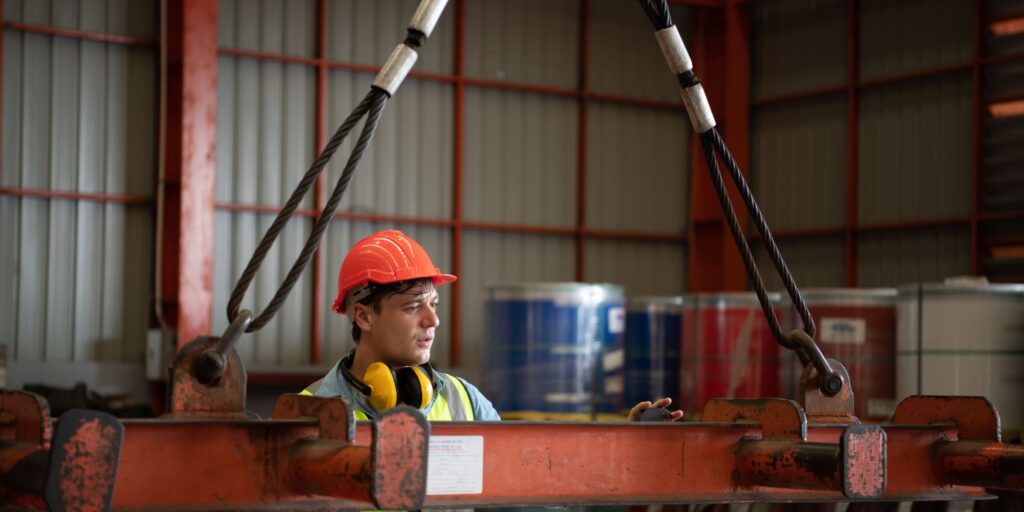
Even where the legal classification is debatable, the need for robust engineering documentation does not disappear.
If an adaptor or cradle-like product forms part of a lifting arrangement, then its structural adequacy matters regardless of what label is attached to it. In many real-world cases, load testing forms an important part of demonstrating that the arrangement is safe and fit for purpose.
That is especially true where:
- the equipment is bespoke
- the lifting arrangement is unusual
- there is no off-the-shelf certified equivalent
- the item has been fabricated internally
- evidence required for approval and use
This is one reason why businesses benefit from getting both the legal classification and the engineering verification considered together, rather than treating them as separate exercises.
A practical way forward
If you are dealing with an adaptor, interface frame, cradle attachment, or similar fabricated item, the safest course is not to rely on assumptions.
Review the item’s actual function. Map the load path. Identify whether it behaves more like a lifting attachment or more like a carrier/support arrangement. Then decide whether to take a reasoned interpretive position or proceed conservatively with conformity assessment as a lifting accessory.
Either way, document the reasoning properly.
How Knox Thomas can help

At Knox Thomas, we support clients with exactly these kinds of classification and compliance questions.
That includes:
- determining whether a product is likely to be a lifting accessory
- reviewing the applicable legislation and standards
- advising on Supply of Machinery (Safety) Regulations 2008 obligations
- considering the relevance of the Machinery Directive and Machinery Regulation where needed
- assessing against EN 13155 where appropriate
- carrying out and supporting proof load testing and associated engineering review
- helping clients build the technical evidence
Where a product sits in a grey area, the right answer is rarely guesswork. It is a combination of legal interpretation, engineering judgement, and practical testing evidence.
If you have an adaptor, cradle, beam, or bespoke lifting item and need help deciding the right route, get in touch with Knox Thomas. We can help you assess the classification, identify the compliance pathway, and support the testing needed to move forward with confidence.