If you’ve ever worked in manufacturing, production, engineering, or just about anywhere with machinery, it’s possible that you’ve had to slap a big red emergency stop button to avoid an accident.
What would you do though, if the button didn’t stop the equipment you thought it would, or if it was out of reach? What about if someone started the machine before you had reset the e-stop?
If you are unsure whether the emergency stop circuits on your machinery meet the standard, Knox Thomas offers EN 60204-1 electrical testing for your machinery, with test records you can put straight into your technical file.
These are dangerous scenarios that are thankfully avoided through proper design and specification of emergency stop controls.
In today’s blog, I’ll provide a guide to emergency stop regulations in the UK, and how they can help you to design and use safer equipment.
What IS An Emergency Stop?
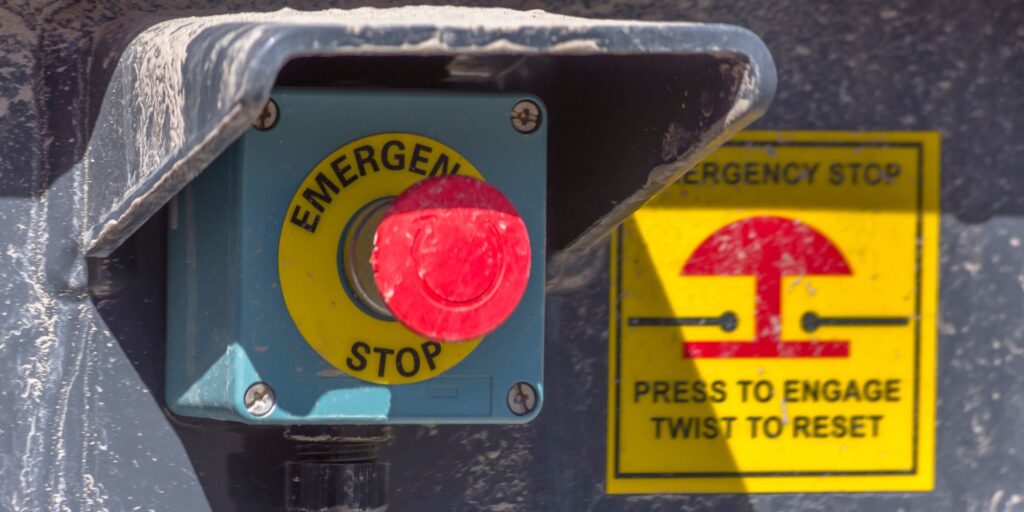
An e-stop is a manually actuated safety function which is designed to stop hazardous machine movement as quickly as possible.
Many people, even those in the health and safety profession, consider an emergency stop as a safeguard, however in reality that’s just not the case. They are a complementary protective measure that is intended to be used in abnormal or emergency situations- rather than during normal use and being used as an everyday means of stopping the machine.
Application of the law

As always, we can consider components of a machine under both a CE-marking and PUWER focus.
When it comes to CE marking, the principal concerns are over the design and function of the e-stop- for example their span of control (what they actually stop), stop category, reset behaviour and restart logic, and how they interact with other safety functions present on the machine.
Without these compliance checks, it is easy for designers to fall into a trap of an e-stop which simply powers off everything on the machine, which can in turn introduce new hazards.
Once supplied, the machine and associated e-stop must then comply with PUWER. Under regulation 16, emergency stop controls must be provided “where appropriate”, be readily accessible, and override other controls. These are risk-based compliance
judgements, which are less prescriptive than the stipulations made by the EHSRs when aiming for CE compliance.
Key Standards
While not mandated by law, compliance with specific standards provide a justifiable and recognised proof of compliance. The principal standards are:
- BS EN ISO 13850: Design principles for emergency stop functions (actuation, reset, priority, span of control),
- EN 60204-1: Electrical equipment of machines, including stop categories and control circuit behaviour,
- ISO 12100: Risk assessment and risk reduction- (the basis for deciding whether an E-stop is required at all),
- ISO 13849-1/IEC 62061- Functional safety of control systems.
When Is An E-Stop Required?
Like all proper risk controls, an emergency stop is required only where it actually reduces risk. A CE or PUWER risk assessment should therefore consider:
- The potential abnormal conditions that may require an emergency stop,
- Who may be required to intervene, for example operators or maintenance staff,
- Realistic scenarios where intervention is required, and
- Whether stopping the machine introduces new hazards, for example falling loads, loss of control, or instability.
Key E-Stop Considerations

If you’re designing equipment, or assessing your new equipment, you may well be asking what are the requirements for an emergency stop button? Here’s my rundown:
Number, Location, Span of Control
A properly designed emergency stop system should ensure that:
- E-stops are reachable from where people operate the equipment, as well as where they may work around the machine. Having a single e-stop by the operator position is rarely sufficient.
- Multiple e-stops are provided where machine are long, complex or accessed at multiple points.
- The span of control is clear- users must know what is going to stop when the button is pressed, this is achieved via proper positioning.
- E-stops are clearly visible, (red button on yellow background) and consistently located/positioned.
In order to achieve the above, it is crucial to comprehensively understand the scope of the machine functions and use.
Stop Categories

Emergency stops are typically implemented within one of the following categories:
- Category 0- providing an immediate removal of power. While straightforward/simple, this may result in an uncontrolled stop, which can introduce additional hazards.
- Category 1- A controlled stop. Power is maintained during deceleration, then it is removed. These may even trigger a reversal or limitation of motion rather than a stop. It is highly unlikely that additional hazards will be introduced by utilising this type of system, however the stop is less immediate, so may not be suitable for applications where a rapid stop is fundamental to achieving a safe condition.
There is an additional category, (Category 2), however this doesn’t apply to e-stops; Category 2 control devices may only be used for operational or “normal” stopping functions, as per ISO 13850.
The correct category choice is not a question of preference- it is a question of risk.
Reset/Restart Logic and Human Factors

Emergency stop controls and devices must latch when actuated (they stay “pressed” until released), require a manual (human) reset action, and must no cause the machine to restart when reset- the “start” button must be pressed after the e-stop has been reset.
Emergency Stop Compliance with Knox Thomas
Throughout my time working in manufacturing I’ve seen my fair share of brand new, expensive machines, sourced from niche manufacturers in Europe as well as the far East. They always come with a proud CE mark and a range of proximity switches, fixed guards and interlocks.
Despite this, these machines have had to have additional e-stops fitted, or the control logic altered within the PLC, or non-compliant e-stops swapped with compliant.
These rectifications delay the commissioning phase and add financial cost to a project too- yet it doesn’t have to be this way.
If you need assurance that your emergency stops and other safety devices are CE-compliant, or that a new machine meets PUWER requirements, Knox Thomas can help. Our assessments take a whole-machine view, ensuring compliance is properly justified, not assumed. Get in touch to discuss how we can support you.
FAQ
1. What is an emergency stop button?
An emergency stop, or e-stop, is a manually actuated safety function designed to stop hazardous machine movement as quickly as possible. It is a complementary protective measure intended for abnormal or emergency situations, not an everyday means of stopping the machine.
2. Are emergency stop buttons required by law in the UK?
Emergency stop controls must be provided “where appropriate” under PUWER Regulation 16. They must be readily accessible and override other controls. Whether one is required depends on a risk-based assessment of the machine and how it is used.
3. What standards apply to emergency stop compliance in the UK?
Key recognised standards include BS EN ISO 13850 for emergency stop design principles, EN 60204-1 for machine electrical equipment, ISO 12100 for risk assessment, and ISO 13849-1 / IEC 62061 for functional safety of control systems.
4. Can resetting an emergency stop restart a machine automatically?
No. Emergency stop controls must latch when actuated, require a manual reset, and must not cause the machine to restart when reset. The normal start button should only be pressed after the e-stop has been manually released and reset.
Need the emergency stop function on a machine verified? Our EN 60204-1 electrical testing service checks protective bonding, insulation, residual voltage and the functional performance of safety circuits, and a PUWER assessment covers the rest of the equipment. Book a free consultation.