Introduction
Workplace safety legislation varies widely across high-income nations, particularly in industry and manufacturing sectors. A key distinction lies in who is held responsible for ensuring safety – the individual worker versus the company (employer or equipment owner/manufacturer). This article examines how differing legislative approaches (personal responsibility vs. corporate responsibility) correlate with safety outcomes over the past decade. We focus on severe incidents (fatalities and life-altering injuries) in high-income countries, and discuss how under-reporting and national culture influence the recorded safety performance.
Legislative Approaches: Individual vs. Corporate Responsibility

Employer/Manufacturer-Centric Laws: Many countries impose a general duty of care on employers (and often on equipment manufacturers) to prevent harm. For example, the EU’s Framework Directive on Safety and Health at Work requires employers to assess and mitigate workplace risks, and the EU’s Machinery Directive mandates that manufacturers design inherently safe machines. Similarly, the UK’s Health and Safety at Work Act places primary responsibility on employers to ensure safety “so far as is reasonably practicable,” and requires safe equipment and training. In these jurisdictions, employees also have duties (e.g. to follow safety procedures), but the legal burden is predominantly on companies and their leaders to proactively manage safety. Notably, an international comparison found that in 7 of 9 examined countries (including Germany, France, Italy, Sweden, Japan, Canada, Australia), safety laws explicitly impose obligations on company directors or executives for maintaining safe operations[1]. By contrast, a country like the United States did not impose specific legal duties on company directors as of that study[2], reflecting a more limited personal liability for those at the top.
Individual-Focused or Decentralised Approaches: In some high-income nations, the regulatory framework is less centralised and can implicitly shift more of the onus onto individual workers. The U.S. Occupational Safety and Health Act (OSHA) does require employers to provide safe workplaces, but the U.S. system relies heavily on specific industry standards and worker compliance rather than broad preventive principles. OSHA regulations tend to be industry-specific and prescriptive, addressing hazards sector by sector[3]. This can lead to a complex web of rules that employers and workers must navigate, and enforcement quality can vary. Indeed, OSHA’s enforcement has been described as “patchy,” raising concerns about consistency across regions[4]. In practice, when rules are overly detailed or enforcement is inconsistent, safety may be treated as a matter of worker rule-following (with accidents often chalked up to “human error”) rather than holistic risk management by companies.
Enforcement and Accountability: Legislative strength is also reflected in how laws are enforced and who is held accountable after an incident. Many European countries feature robust labour inspectorates and the possibility of corporate or even criminal liability for employers in serious safety breaches (for example, the UK and France can prosecute companies or managers for gross negligence leading to a worker’s death). Such mechanisms enforce the principle that ultimate responsibility lies with management. By contrast, in jurisdictions where enforcement penalties are weaker or top management is less directly accountable, there may be greater reliance on individual workers to avoid accidents through personal vigilance. Over the past 10 years, the gap in regulatory stringency between Europe and some other regions has widened – observers note that rules are now “far more stringent in Europe than in the US”[5]. The EU’s centralised approach (framework directives supported by EU-OSHA guidance) claims to create a “robust system to ensure worker safety,” exemplifying high standards, whereas the U.S. approach can suffer from inconsistency and gaps in protection[5].
Impact on Safety Incident Rates
There is a notable correlation between these legislative approaches and actual safety outcomes, especially in terms of fatal workplace incidents. Countries with stricter, employer-centric safety regimes generally report lower rates of fatal accidents than those where responsibility is more diffuse. For instance, the United Kingdom consistently has one of the lowest workplace fatality rates in Europe – about 0.5 deaths per 100,000 worker in recent years[6]. This is in line with the UK’s strong enforcement and safety culture, where businesses are required to have risk assessments and safety policies, and workers are empowered to refuse dangerous work. Similarly, Germany’s standardised fatality rate was around 0.5–1.1 per 100,000[6][7], and Japan’s rate has fallen to roughly 1.1 per 100,000 (755 deaths among ~67 million workers in 2023, the lowest on record)[8]. In contrast, the United States has a much higher fatal work injury rate – about 3.5–3.7 deaths per 100,000 workers in recent years[9] – roughly several times the UK or German rate. Other high-income countries fall in between; for example, Canada’s most populous provinces hover around 1.7 per 100,000[10], while France (known for strict labour laws but with a high-risk industry mix) has around 2.5–2.8 per 100,000[11].
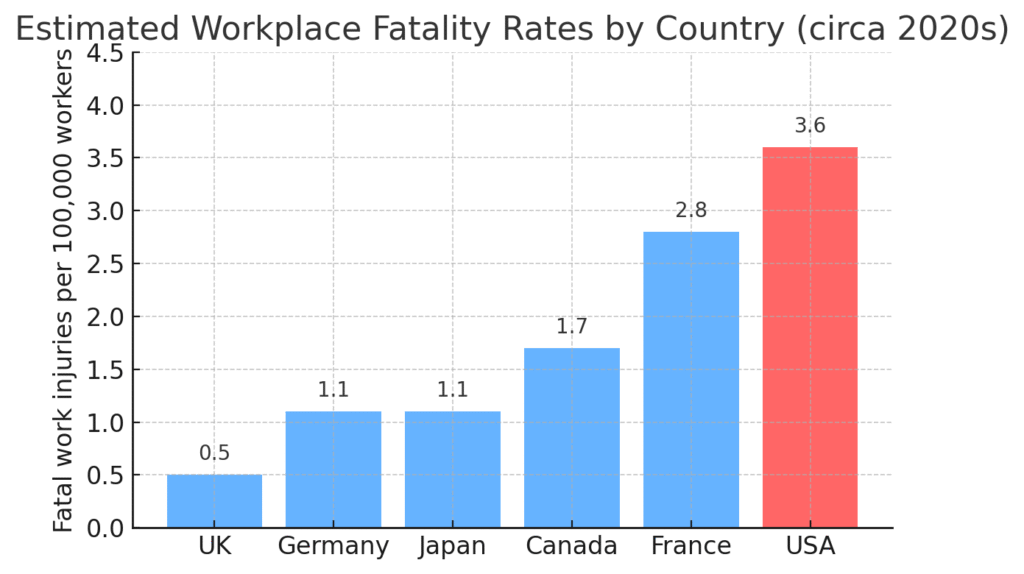
Figure: Approximate fatal workplace injury rates per 100,000 workers in select high-income nations (circa 2018–2023). Countries with strong corporate safety accountability (e.g. UK, Germany, Japan) tend to have markedly lower fatality rates than countries where safety regulation and enforcement are less stringent or more decentralised (e.g. the USA)[6][9].
These statistics suggest that placing greater responsibility on employers and manufacturers correlates with safer outcomes. When companies must invest in safer equipment, training, and risk management (and face serious consequences for failures), fewer workers die or suffer catastrophic injuries on the job. For example, in the manufacturing sector, one study noted the U.S. fatality rate was about double that of the UK in the 2000s[12]. Conversely, where regulations rely more on individual compliance or where enforcement is lax, higher accident rates persist. The U.S., despite having advanced technology and resources, continues to see occupational fatality rates roughly 3–4 times higher than many EU countries in construction, manufacturing, and other high-risk industries[12][13]. This gap has been relatively consistent over the past decade – Europe has generally seen a downward trend in work fatalities (the EU average fatality incidence fell ~19% from 2012 to 2019)[14][15], while the U.S. rate has fluctuated only slightly (even rising again in 2021–2022)[9].
It’s important to note that industry composition and other factors also play a role in national statistics. Countries like France or Canada, with larger mining, forestry, or construction sectors, naturally face higher baseline risks. However, even when comparing similar sectors, stricter safety regimes often show safer results. For instance, construction fatality rates in the U.S. have been recorded at 2–3 times those in the UK[12], highlighting the impact of different safety practices and regulations in the same industry.
Under-Reporting and Data Reliability

Any comparison of incident rates must consider the potential for under-recording of accidents, especially non-fatal ones. High-income countries generally have established reporting systems, but even among them there are differences in coverage and accuracy. Under-reporting can stem from cultural and economic incentives: workers might not report injuries due to job security fears or cumbersome processes, and employers might under-report to avoid regulatory scrutiny or increased insurance costs[16]. For example, in Canada a recent study flagged “claim suppression” by employers (pressuring workers not to file injury claims to keep insurance rates low) as a persistent issue[16]. Similarly, studies in Sweden found that precariously employed workers had significantly higher under-reporting of injuries than others[17].
Differences in record-keeping can make one country appear safer than another on paper. A revealing metric is the ratio of reported non-fatal injuries to fatal injuries (sometimes called a “lethality index”). In a country with comprehensive reporting, for every one fatal accident we expect many hundreds or thousands of non-fatal injuries to be recorded (since less severe accidents are far more common). In the European Union in 2022, there were about 905 non-fatal accidents (≥4 days lost) for every fatal accident[18]. The UK likewise reports thousands of injuries per fatality in labour force surveys, reflecting thorough reporting of even minor incidents. By contrast, some high-income countries report much lower ratios. Japan in 2023 recorded ~135,000 injury cases (≥4 days off) to 755 deaths – roughly 179 injuries per fatality[8][19] – a far lower ratio than the EU. This suggests that many less serious accidents in Japan may go unreported or uncounted in official stats (possibly due to higher reporting thresholds or cultural disincentives to report “small” injuries). The United States falls in between: the U.S. Bureau of Labor Statistics reported about 2.7 million nonfatal injury cases in 2020 against ~4,800 fatalities, roughly 560 to 1 (and this excludes public sector and minor injuries). Germany, with its very robust reporting, once showed fewer than 9 fatal injuries per 10,000 total reported injuries[20] – about 0.09% – whereas some countries with weaker reporting (historically) showed an alarmingly high percentage of fatalities among reported cases (e.g. Turkey, ~30% in the 1990s)[20]. Such disparities underline that caution is needed when comparing international safety data[21]. A lower officially reported injury rate could mean safer workplaces, but it could also mean injuries are under-recorded. Therefore, this article emphasises fatality rates (which are more consistently tracked) as a benchmark for safety outcomes, while acknowledging the uncertainties in non-fatal incident data.
Notably, countries that place responsibility on employers often also have more rigorous reporting mandates (e.g. EU countries require employers to report work injuries above a certain severity) and stronger surveillance systems. This tends to reduce under-reporting over time. In the last decade, some high-income nations have launched initiatives to improve reporting accuracy – for example, provinces in Canada conducted studies and awareness campaigns on injury under-reporting to identify gaps[22]. These efforts recognise that transparent data is critical: without it, businesses and regulators might be lulled into complacency by artificially low incident figures. In countries where a “blame culture” exists (penalising workers for accidents), under-reporting is likely higher, whereas in a more “learning culture” (encouraging reporting of near-misses and small injuries to fix hazards), the reported injury numbers may be higher but actual severe incidents lower.
Severity of Incidents and Long-Term Consequences

By focusing on fatalities and life-altering injuries (e.g. amputations, permanent disabilities), we get a clearer picture of how well different systems prevent the worst outcomes. The past 10 years have seen gradual improvement in many places – for example, Japan halved its annual work-related deaths from over 2,000 in the 1990s to 755 in 2023[23][8]. This improvement aligns with sustained efforts by Japanese authorities and companies to invest in safety technology and training (although, as noted, their non-fatal injury numbers have risen, possibly due to better reporting or an aging workforce). In the EU, fatal accidents dropped about 9% from 2012 to 2019[14], continuing a longer downward trend thanks to stricter EU-wide directives and national initiatives. High-income countries increasingly focus on preventing severe incidents, operating on philosophies like “Vision Zero” (zero fatalities) or “zero harm”.
Nevertheless, differences in severity persist. The United States experiences not only more fatalities per capita, but also more serious non-fatal incidents in certain sectors than peer nations. For instance, machine-related accidents remain a major cause of severe injury in U.S. industries: each year, an estimated 18,000 American workers suffer amputations, crush injuries, or other serious harm from machinery, and over 800 are killed by machines[24][25]. These numbers dwarf those in countries like the UK, which in some recent years saw on the order of ~140 total workplace fatalities across all causes (not just machines)[6]. Part of this difference is due to the larger U.S. workforce, but even rate-wise the U.S. has higher incidence of traumatic injuries. In contrast, many European countries have concentrated on “safety by design” – requiring better machine guarding, fail-safes, and ergonomic designs – which has reduced the frequency and severity of accidents. For example, dangerous machinery in the EU must be equipped with protective guarding as a legal prerequisite, whereas in the U.S., machine guarding rules exist (OSHA standards) but older equipment without adequate safeguards still causes injuries and OSHA repeatedly cites companies for these violations[26]. The responsibility in Europe extends back to the machine manufacturers to eliminate hazards before the equipment even reaches the worker, illustrating again how assigning responsibility upstream leads to safer outcomes.
When severe incidents do occur, the legal and cultural response differs by country. In nations with strong corporate accountability, a worker’s death is often met with thorough investigation and potential prosecution of the employer for safety lapses (e.g. corporate manslaughter charges or heavy fines), reinforcing the message that such events are unacceptable and preventable. In places where individual responsibility is emphasised, there may be a tendency to attribute the cause to operator error or “acts of God” and less often to scrutinise systemic failures. This can affect prevention of future incidents – if a fatal accident is blamed solely on a worker’s mistake, the company might not improve its training or equipment, setting the stage for repeated tragedies.
Another aspect of severity is how incidents are recorded in statistics. Some countries may classify certain long-term occupational disease deaths (like cancers from exposure) as work-related fatalities, while others do not, which can affect the numbers. For consistency, our discussion has focused on acute traumatic incidents (accidents) rather than chronic occupational illnesses. It’s worth noting, however, that in places like Canada, when occupational diseases (e.g. asbestos-related cancers) are included, they find two-thirds of workplace fatality claims are actually due to diseases developing over time[27]. Such cases are often under-recognised in official counts globally. Responsibility for preventing these also ties back to legislation – e.g. stricter company duties to limit exposure to toxins result in fewer fatal illnesses decades later.
Influence of National Culture on Safety
Beyond written laws, the culture of a country heavily influences safety performance and reporting. Culture shapes attitudes toward risk, authority, and accountability. In high-income countries with a strong safety culture, there is a common understanding that every worker has the right to a safe workplace and that accidents are largely preventable. For example, in the UK and Scandinavia, it’s culturally reinforced that speaking up about hazards is not only acceptable but expected – this aligns with laws that protect workers who refuse unsafe work. Surveys show most UK workers are confident their job does not put them at undue risk, and UK businesses are more likely to have formal safety policies and risk assessments compared to many European peers[28]. This reflects a national ethos that values proactive safety management, not just compliance on paper.
In contrast, consider countries where hierarchical or high-pressure work cultures prevail – employees may be reluctant to question a supervisor’s unsafe instructions or to halt work even if conditions are hazardous. For instance, Japan’s culture of respect for seniority and a “gambaru” spirit (persevering through adversity) can sometimes impede open discussion of safety concerns, even though Japanese law empowers workers to refuse dangerous tasks. Overwork is another culturally influenced issue – Japan has grappled with “karoshi” (death from overwork), which, while not an acute accident, shows how cultural norms about work intensity can become a serious safety and health issue. Japan has responded culturally and legally with campaigns to change attitudes toward overtime and rest.
The United States’ culture, being more individualistic, historically embraced a notion of the “rugged” worker and sometimes a tolerance for risk in pursuit of productivity. This was seen in earlier decades with terms like “accident-prone” workers, subtly placing blame on individuals. However, there has been cultural shift: many U.S. companies now talk about “safety culture” and emphasise that management must foster safe practices. Still, the litigious environment in the U.S. can cut both ways culturally – on one hand, fear of lawsuits can motivate companies to improve safety, but on the other hand, it might also discourage transparent internal reporting of near-misses (to avoid creating evidence of issues). The result is a culture that is improving but still often reactive rather than preventive compared to some European counterparts.
National culture also affects recording of incidents. In a “blame culture,” a worker who admits to a mistake that caused a minor accident might face discipline, so neither the worker nor the employer has incentive to report that incident. This leads to under-reporting (and lost learning opportunities). In a more “just culture,” embraced by many high-income nations’ regulators now, the focus is on understanding why an error happened and fixing the underlying cause, rather than punishing the individual. Such an approach encourages reporting of even small incidents and near-misses. Countries with just cultures (often those with strong social safety nets and collaborative labour relations, like Scandinavia, Germany, the UK) typically gather more complete data and can address issues before they escalate to fatalities. Culture also influences how safety is prioritised versus productivity: for example, some Northern European cultures generally refuse to compromise safety for speed, whereas in other places there may be a tacit acceptance that “the job must get done” even if corners are cut, which elevates risk.
Finally, societal value placed on each human life plays a role. High-income nations universally regret workplace fatalities, but the public and media response to incidents can differ. In some countries, a single fatal accident (especially a disaster) prompts national outrage, memorials, and swift policy responses. In others, fatal accidents – especially if scattered and not in headline-grabbing disasters – may receive relatively little public attention, seen as an unfortunate cost of doing business. The Canadian report on 2023 fatalities began with a dedication naming each lost worker[29], underlining that behind the statistics are real people – this humanising approach can influence culture by reminding everyone that safety isn’t just a regulatory checkbox but a moral imperative.
Conclusion
Over the last decade, evidence from high-income countries demonstrates a clear relationship between safety responsibility frameworks and safety outcomes. When legislation squarely places responsibility on businesses – from the boardroom to the factory floor – and on those who design and maintain equipment, workplaces tend to be safer. Nations like the UK, Germany, and Japan (and many others in Western Europe) have built systems of accountability that drive employers to actively prevent harm, yielding some of the lowest workplace fatality rates in the world[6]. In these countries, a supporting culture of safety has developed: workers are encouraged to report hazards, and companies integrate safety into their management practices. By contrast, countries where responsibility for safety has historically been more fragmented or tilted toward individual workers (for example, via complex regulations that are not uniformly enforced) have comparatively higher rates of deadly incidents[13][4]. The United States, despite improvements, is a prominent example – its worker fatality rate remains several times that of peer economies, implying in part the consequences of less centralised regulation and inconsistent safety oversight[12][9].
Crucially, the accuracy of incident data is intertwined with these factors. A strong safety culture and legal framework not only prevent accidents but also promote honest reporting when incidents and near-misses do occur. Countries vary in their transparency – some may “lose” non-fatal incidents to under-reporting, which can mask problems and delay corrective action. The best-performing nations on safety metrics are often those that pair high standards with high transparency, ensuring that for each tragic fatality, hundreds of minor incidents are reported and investigated to learn from them[18][21]. On the other hand, if accidents are swept under the rug, the official record might look rosy even as workers remain at risk.
In terms of culture, it’s clear that legislation and culture reinforce one another. Laws set the expectations and is inherently a reflection of a culture, but then societal values determine how faithfully those laws are implemented on the ground. High-income countries that have made the greatest strides in industrial safety over the past ten years foster a culture where safety is everyone’s responsibility – but ultimate accountability lies with the employer. Workers are empowered to be vigilant, yet they are not expected to bear the primary burden of an unsafe environment. This contrasts with places where, culturally, accidents might be seen as the worker “being careless” rather than management failing to provide safeguards. Such attitudes are gradually fading as global best practices spread, but they can still influence how safety is managed and how incidents are recorded.
In summary, the relationship between responsibility, legislation, and safety outcomes is evident: when companies are held accountable for protecting their employees, fewer workers die or are maimed on the job. High standards and enforcement do not hinder industry; rather, they drive innovation in safety and build trust in the workforce. Countries that underestimate or under-report their workplace incidents only postpone reckoning with hazards – and risk cultural complacency. The past decade’s data and experiences suggest that the most successful high-income nations in safety are those that combine rigorous legislation, diligent enforcement, accurate reporting, and a culture that values worker well-being. The differing numbers across countries show that policy and culture choices truly can save lives[30][6].
Sources: High-income country safety statistics and legislation analyses from HSE (UK)[21][6], BLS/OSHA (US)[9][24], Eurostat[14], academic studies[20], and news reports[16][8]. These provide comparative insight into how responsibility frameworks impact incident rates and reporting practices.
[1] [2] RR535 – International comparison of health and safety responsibilities of company directors
https://gkstill.com/Support/Links/Documents/rr535.pdf
[3] [4] [5] EU vs. US Regulations for Industrial Companies
https://datafisher.com/news/compliance-contrasts-eu-vs-us-regulations-for-industrial-companies/
[6] [7] [11] [21] [28] Comparisons with other European countries – HSE
https://www.hse.gov.uk/statistics/european/
[8] [19] [23] Fewer Workplace Deaths in Japan in 2023, But More Missed Days Due to Injury | Nippon.com
https://www.nippon.com/en/japan-data/h02011/fewer-workplace-deaths-in-japan-in-2023-but-more-missed-days-due-to-injury.html
[9] Fatal Work Injuries Up 9% in 2021 – NASP
https://www.naspweb.com/blog/fatal-work-injuries-up-9-in-2021/
[10] [16] [22] [27] [29] [30] National report shows rise in workplace fatalities in 2023 | Canadian Occupational Safety
https://www.thesafetymag.com/ca/topics/safety-and-ppe/national-report-shows-rise-in-workplace-fatalities-in-2023/533435
[12] [13] [20] Occupational fatality risks in the United States and the United Kingdom
https://foundation.assp.org/docs/study_rand2011.pdf
[14] [15] [18] Accidents at work – statistics by economic activity – Statistics Explained – Eurostat
https://ec.europa.eu/eurostat/statistics-explained/index.php?title=Accidents_at_work_-_statistics_by_economic_activity
[17] Under-reporting of non-fatal occupational injuries among precarious …
https://pmc.ncbi.nlm.nih.gov/articles/PMC8685629/
[24] eTool : Machine Guarding | Occupational Safety and Health … – OSHA
http://www.osha.gov/etools/machine-guarding
[25] Machine guarding and amputation prevention
https://www.tdi.texas.gov/tips/safety/machineguard.html
[26] OSHA’s Top 10 Most Frequently Cited Standards: Machine Guarding
https://www.ehs.com/2024/01/oshas-top-10-list-of-most-frequently-cited-standards-machine-guarding/