Something we often encounter when on site, or talking at events, is the confusion between regulation acronyms. Is it LOLA, LOLAR or LOLER? Is it PUWAR or PUWER? And what does each refer to?
In todays blog, I’ll explain the differences between the two most frequently confused regulations- LOLER, and PUWER.
Intro to LOLER and PUWER

Both LOLER and PUWER are statutory instruments introduced under the Health and Safety at Work Act 1974.
LOLER stands for the Lifting Operations and Lifting Equipment Regulations 1998. The three key principles of the regulations are to ensure that both lifting equipment, and lifting operations, are safe, properly planned, and carried out by competent people.
LOLER applies across all workplaces and work activities that involve lifting, whether that’s construction, warehousing, manufacturing, agriculture, or anything else in between.
PUWER (Provision and Use of Work Equipment Regulations 1998) is very different. The purpose of these regulations to ensure work equipment is safe, suitable, properly maintained, and used by competent people.
A similarity to LOLER however, PUWER applies to all workplaces where work equipment is used.
Lifting the Lid Off LOLER
How might LOLER affect your business? There are many responsibilities for employers under LOLER, however fundamentally these revolve around:
- Thorough examination: lifting equipment used to lift people, and all lifting accessories, must be examined every 6 months; all other equipment every 12 months.
- Safe working loads: equipment must have the WLL (working load limit)/ SWL (safe working load) marked and be used within that capacity.
- Marking of accessories: must be marked with SWL/WLL, be traceable, and included in an equipment register.
- Planning of lifting operations: every lifting operation must be properly planned, appropriately supervised, and carried out safely.
- Installation and positioning: equipment must be installed to minimise risk of overturn/collapse, positioned to reduce hazards, and stabilised/secured as appropriate.
- Strength and stability: equipment must have adequate strength and stability; by way of equipment selection, use of outriggers, counterweights, mats.
- People lifting: additional provisions apply in this case, to prevent falls, entrapment, or unintended movement.
- Control of dangerous and suspended loads: events such as load fall/slip, hook failure, or people entering under suspended loads must be prevented.
- Failure reporting: defects that present an immediate threat must be reported to the HSE.
Businesses often fail to comply with LOLER due to poor control of lifting accessories, for example where their age and WLL is unknown, or stored poorly; often lifting operations are planned poorly due to a lack of competent expertise. Inadequate pre-use checks are also a common route of non-compliance, or using equipment beyond their intended purpose.
Applying PUWER
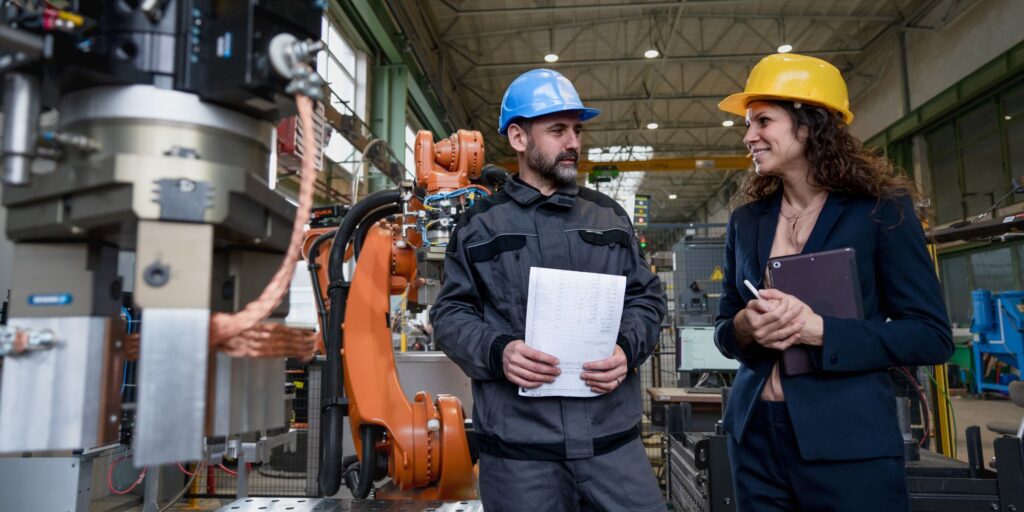
PUWER applies to just about all equipment used at work, for example:
- Production machinery,
- Mobile plant,
- Hand-held tools,
- Maintenance equipment,
- Fixed machines such as CNC machines, saws, etc.
PUWER applies to all businesses regardless of their size or industry sector.
Responsibilities under PUWER include:
- Ensuring that work equipment is appropriate for the task and suited to the environment.
- Maintaining equipment in a safe condition, inspecting it at appropriate intervals, and keeping records of both.
- Inspecting the equipment upon commissioning, reassembly, or when deterioration is likely.
- Ensuring that equipment has clearly marked and accessible controls, functional control systems, proper guarding, suitable warning devices and protection from electrical, mechanical, thermal or chemical hazards.
- Providing suitable information, instruction and training to anyone required to use the equipment.
- Considering ergonomics, fatigue and strain, manual handling, control layout, etc.
- Reassessment should the equipment be modified.
Non-compliance with PUWER can result in an increased likelihood of accidents occurring, enforcement notices and criminal prosecution in the event of such accidents, and indirect issues such as problems regarding insurance cover, or even a deterioration in safety culture.

Free Tool
Simple but Powerful PUWER Assessment App
A simple, easy-to-use app for checking PUWER compliance — usable on Apple, Android, and desktop browser. No intensive auditing or complicated report writing.
Regulatory Crossover
By now you should understand that LOLER and PUWER are rather different. LOLER only applies to lifting equipment, while the other has all work equipment within scope. LOLER mandates examinations at specific intervals, whereas PUWER assessments are carried out according to risk. LOLER is more interested in the integrity of (lifting) equipment and safe execution of lifting
operations, whereas PUWER ensure that equipment is fit for purpose, properly maintained, and used safely.
So where are the crossovers, if any? Well, the obvious one is if equipment is used for lifting, it needs to comply with LOLER and PUWER. When selecting equipment such as cranes, hoists, MEWPs or slings, they must satisfy PUWER suitability as well as LOLER lifting performance requirements.
When it comes to maintenance, PUWER requires maintenance and inspection where significant risk exists, rather than at fixed intervals as mandated by LOLER. The person using or maintaining the equipment must simply be competent, however to carry out a LOLER Thorough Examination, the competent person must have “practical and theoretical knowledge and experience”.
At the sharp end, PUWER requires general procedures and controls in place to ensure safe use, such as guarding and protocol. LOLER however requires each specific lifting operation to be properly planned, supervised, and carried out safely- a blanket approach to risk control won’t suffice.
Assessment with Knox Thomas
While PUWER assessment may appear to be more “simple” to carry out, the reality is that to do a thorough and effective assessment, it takes expertise in machinery, knowledge of how to interpret the regulatory criteria, and sufficient time to identify and assess the hazards presented by the machine. More often than not, this is a task that is beyond the capabilities of an in-house team, or simply too time consuming.
That’s where Knox Thomas step in. We’ll thoroughly assess your equipment, using state of the art assessment techniques, that not only ensure every check, question and inspection is made, but that they’re achieved in the most efficient way possible- minimising any operational disruption, and saving you money. We have the experience to determine what a sensible and pragmatic risk control looks like, and how to integrate them into your machinery in a way that reduces risk while maintaining operational efficiency.
To discuss how we can assess your machinery for PUWER compliance, or ensure LOLER inspections are carried out on time, get in touch today.