Consider your average single or multi-stage ladder in the workplace: wood, aluminium or fibreglass construction, no moving parts, nothing powered, simple to use. You’d be forgiven for thinking that you can simply grab them, prop them against a wall and start climbing.
In truth, and despite their simplicity, both fixed and mobile ladders need to be inspected to ensure that they are safe to use. In todays blog, we’ll explain why, and how you should do a ladder inspection.
Ladder Inspection: Why?
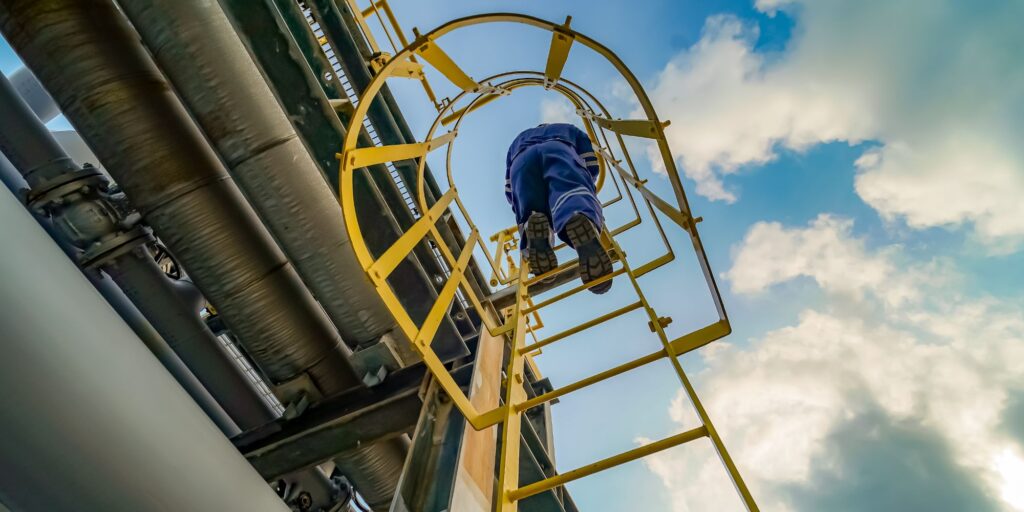
There are several reasons why you should be doing a ladder inspection- they’re important to do from a due diligence point of view, as well as to reduce risk, and of course (and last of all), maintain legal compliance.
Due Diligence
If you have potentially unsafe equipment, or simply equipment that carries an inherent level of risk, it is morally right to assess the equipment and put safeguards in place, in order to look after the wellbeing of your workforce.
Risk Reduction
Another good reason to inspect your ladders, is to reduce risk. Reducing risk by way of ensuring equipment is safe to use will result in fewer accidents or incidents, which of course avoids associated direct and indirect costs such as fines and penalties, loss of productivity, downtime, and loss of employee morale or company reputation. It may also help satisfy your insurers or client demands.
Legal Compliance
Maintaining legal compliance is often cited as the first reason to reduce risk, but on an ethical level, it should come last- so here it is. Under the Provision and Use of Work Equipment Regulations 1998, a ladder is considered as “work equipment” and as such must be assessed for compliance.
What this means in practice is that the ladders should be assessed prior to first use in the workplace, however there should also be a scheme of inspection in place, ensuring that damage or deterioration that may occur in use or over time is identified.
The Work at Height Regulations 2005 also require ladders to be suitable for the task they are used for, be set up correctly, strong enough for the task, be operated by trained users, and…be inspected at suitable intervals (regulation 12).
As an aside, there are other benchmarks for safety of ladders, where compliance helps demonstrate legal compliance. These are EN ISO 14122 – Safety of machinery – permanent means of access, which relates to safety of fixed ladders, stairs, platforms and guardrails, and is a harmonised standard under the Machinery Directive / UK Supply of Machinery (Safety) Regulations, and BS 4211 – Specification for ladders for permanent access, which is a UK standard, relating to fixed ladders. While compliance with these is not legally mandated, compliance with them will strengthen your case for compliance under scrutiny.
Ladder Inspection: How?

So, how do you inspect a ladder? Great question. As I mentioned, ladders should be assessed for PUWER compliance from the outset. For this, you can use a standard PUWER checklist.
For more day-to-day inspection, you could use a slightly different checklist, which concentrates on the actual condition of the ladders, for example:
- Presence of corrosion, rot or degradation,
- Presence of dents, cracks, splits, bends, crushing or distortion,
- Stile/rail, rung/step/tread, feet/end cap, and locking mechanism conditions
- Missing fixings such as rivets, screws or bolts,
- Smooth operation of hinges and slideways,
- General condition, missing components, modifications.
Who can do a Ladder Inspection?
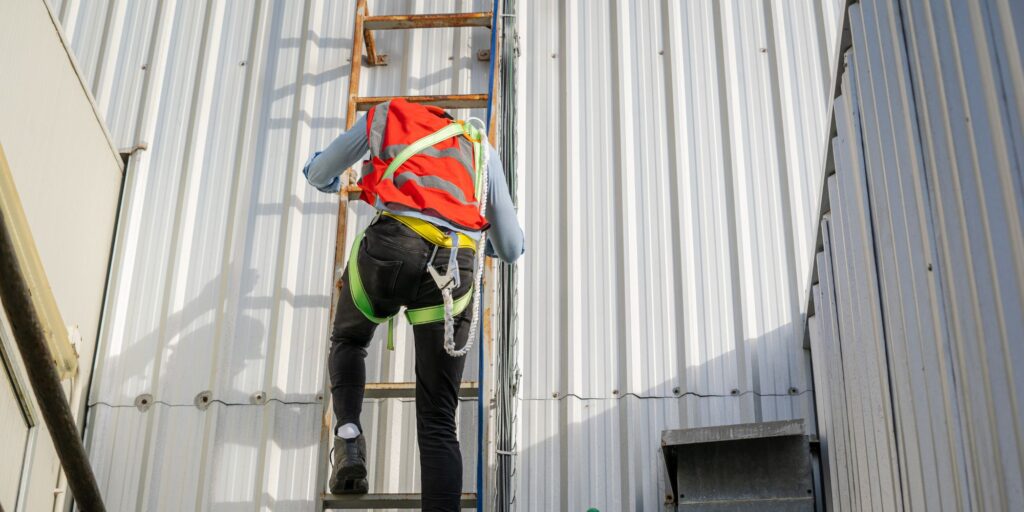
Ladders are pretty basic equipment. So can anyone inspect a ladder?
In true HSE style, the answer lies within a bit of a grey area:
You don’t need a formal qualification or licenses to inspect ladders- so this broadens the field of who can do it- however they must still be competent. As usual, competence can be defined by using the SKATE criteria (skills, knowledge, attitude, training, experience).
- Skills: less relevant in this context, but fundamental- whoever you plan to carry out the ladder inspection needs to be physically able to do it. Whether that’s the strength to lift the ladders, open and close them, and generally handle them in order to assess them.
- Knowledge: to do a ladder inspection, you should have a good understanding of ladder types and their components, and typical defects. You should also have an awareness and access to INDG455 and GEIS6, as well as knowledge of the WAH Regulations 2005 and PUWER 1998.
- Attitude: you should be minded to do a thorough job of the assessment, realise it’s value, and generally take it seriously.
- Training: while not essential, it is helpful to have someone known to be competent to assist you in your initial ladder assessments. You could of course confirm this with a formalised course, just to be sure.
- Experience: you should have had working experience of ladder use. This helps to recognise and identify damage, faults, or issues with the ladders, or ways that they may not be suitable for their intended purpose.
Ladder Inspections with Knox Thomas

Ladder inspections come in two guises: initial/periodic PUWER assessment, and routine condition inspection. Whichever type, they can take time to complete, and frankly, be a distraction.
If a ladder inspection sounds like a worthwhile endeavour, but something you simply don’t have the time or competence for, we can help. We can include your ladders within a wider PUWER assessment project, or even carry out routine inspections on site on your behalf.
To discuss how you can ensure ladder inspections are carried out on your site, get in contact today.